
If you’ve been applying to software engineering internships and hearing nothing back: no emails, no calls, nothing, your resume format might be the problem. Not your skills. Not your experience. Your format.
I was in that exact position. I was applying to internship after internship using random templates I found online, and I was getting zero interviews. Zero.
I didn’t realize at the time that most of those templates were completely failing the ATS (Applicant Tracking System). The automated software companies use to filter resumes before a human ever sees them.
Once I figured out the right structure and optimized for how the ATS actually works, everything changed. This is the exact framework I use, and it’s what I’m sharing with you today.
Before we get into it, I am reviewed thousands of resumes and helped hundreds of students land internships with this format.
This advice + resume format has also helped me get internships at Apple and Verizon. It really works.
What Is an ATS and Why Does It Matter for Your Internship Resume?
What is ATS? Who is ATS? Before we get into the how, here’s the why. Most large companies run every resume through an ATS before a recruiter ever looks at it.
The ATS scans your resume for relevant keywords, structure, and formatting. If your resume isn’t formatted correctly or uses fancy design elements that confuse the parser, it gets filtered out automatically.
Think of it as a bot that filters out based on your format and keywords.
This is why a lot of well-qualified candidates never hear back. It’s not that they’re unqualified. Their resume just never made it to a human.
Most students have never hard of this or don’t know what it is. Now that you know, you are one step ahead.
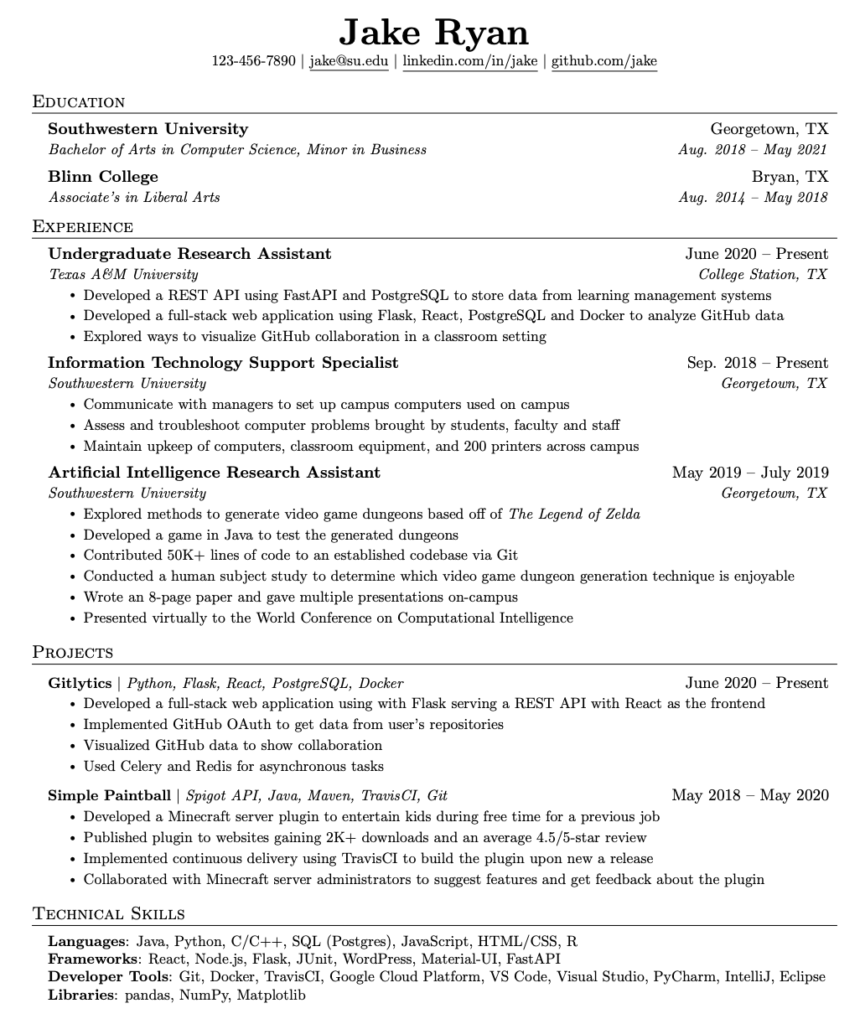
The Gold Standard Template: Jake’s Resume
The template I personally started with, and still base my resume on is Jake’s Resume. It’s clean, ATS-friendly, and widely recognized in the software engineering community. I use a variation of it, but Jake’s Resume is the cornerstone. Start there.
I will show you how it looks, then break down why it works.
Here is what it looks like:
Software Engineering Internship Resume: The Non-Negotiable Rules
1. Keep It to One Page
No matter how much experience you have, your resume should be one page. This is the standard for internships and early-career software engineering roles. Recruiters spend an average of 7 seconds on an initial resume scan. Read that again. 7 SECONDS. One page forces you to prioritize what actually matters.
2. Keep the Formatting Clean and Editable
Your resume should be clean and easy to read, but just as importantly, it needs to be easy for you to edit. You’ll be tailoring it for different roles and companies, so a simple, editable format saves you a lot of time down the road.
Avoid tables, columns, text boxes, or graphics. These break ATS parsers. You don’t need them anyway.
3. Order Your Sections by Relevance
The order of your sections matters. Arrange them based on what’s most relevant to the role you’re applying for. For software engineering internships, the standard order is:
- Education
- Skills
- Experience
- Projects
- Additional / Extracurriculars / Affiliations
That’s the format I use.
Breaking Down Each Section
Education
Keep this simple. List your university name, your expected graduation date, and your degree. That’s it. If your GPA is strong (3.5+), include it. If not, leave it out.
Skills
List your technical skills, programming languages, frameworks, tools, and technologies. Tailor this section to match the keywords in the job description. This is critical for ATS optimization.
I will have another guide on how to tailor your resume out soon.
Experience
List your experiences in reverse chronological order, newest to oldest. This applies to internships, part-time roles, research positions, and relevant work history.
This is also where the XYZ bullet point format becomes your most important tool (more on this below).
Projects
List your projects in reverse chronological order as well. For projects, skip the dates and instead link directly to the project GitHub repo, live demo, or portfolio link. Projects are one of the most important sections for early career engineers, especially when professional experience is limited.
File Format and Naming
Always save and submit your resume as a PDF. Name the file clearly. Something like FirstName_LastName_Resume.pdf or simply FirstName_LastName.pdf. This keeps it professional and easy for recruiters to find.
The XYZ Bullet Point Formula: How to Show Real Impact
This is the single most important thing you can do to improve your resume bullets. Every bullet point should follow this structure:
Accomplished [X] by doing [Y], which resulted in [Z].
For example:
- Reduced API response time by 40% by implementing Redis caching, which improved the overall user experience for 10,000+ daily active users.
- Built a full-stack web application using React and Node.js that automated a manual reporting process, saving the team 5+ hours per week.
You see how much more powerful that is?
The XYZ format forces you to show impact, not just tasks. Recruiters and engineers reviewing your resume want to see what you actually accomplished, not just a list of responsibilities. Quantify wherever you can. Numbers stand out.
Think of Your Resume as a Living Document
Here’s a mindset shift that changed how I approach this: treat your resume as a living document, not a static file you submit once and forget.
Maintain a master resume that contains every experience, project, skill, and achievement you’ve accumulated. When you apply for a specific role, pull from that master document and customize your resume to match the job description.
Tailor the keywords. Reorder projects. Adjust your skills section. This targeted approach dramatically improves your chances of passing the ATS and resonating with the recruiter.
What If You Don’t Have Enough Experience to Fill Your Resume?
This is the most common concern I hear, and it’s very solvable.
I have a full guide on how to gain experience as a software engineering student even when you have none, covering everything from personal projects and open-source contributions to research opportunities and freelance work.
These are real experiences you can put on your resume and speak to confidently in interviews.
Summary: Software Engineering Internship Resume Checklist
- One page, clean formatting, no graphics or tables
- Use Jake’s Resume as your base template
- Section order: Education → Skills → Experience → Projects → Affiliations
- Reverse chronological order for experience and projects
- Link projects to GitHub or a live demo
- Use the XYZ bullet format for every bullet point
- Quantify your impact wherever possible
- Save as PDF with a clean, professional file name
- Maintain a master resume and tailor it for each application
Getting more interviews starts with a resume that actually gets seen. Once you dial in the formatting and learn how to communicate your impact clearly, the callbacks will follow.
Just stay consistent.
If you found this helpful, check out my other free guides:
Leave a Reply